The morning belongs to the body, not to making
Movement, food, light, prayer, loose planning — no production pressure. The green zone is deliberately generous: the goal is to arrive at the Duha midpoint regulated, not to have achieved anything.
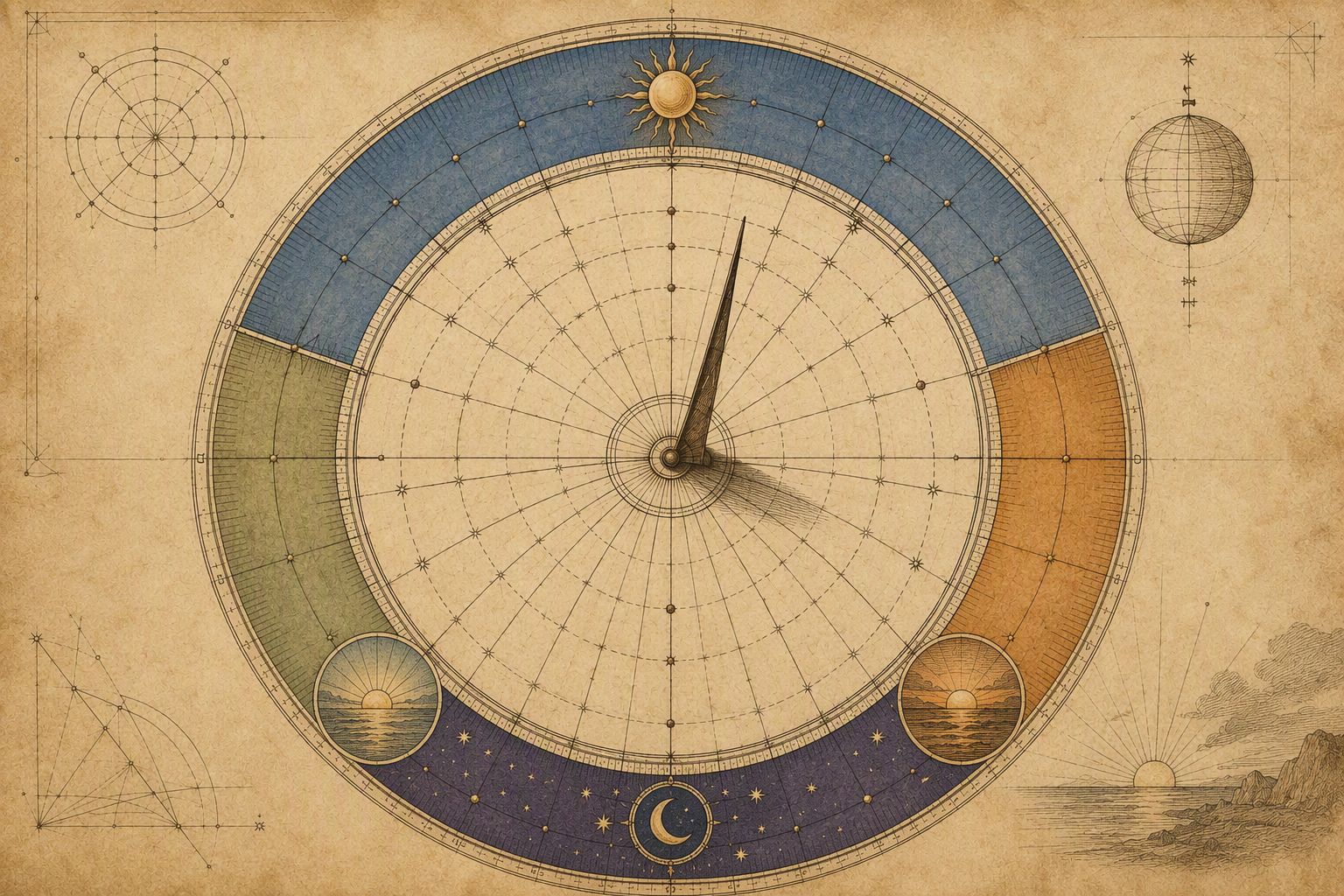
Most productivity systems fight the body; the traditional Islamic solar day was never a pacing tool. This small handbook joins them — three coloured zones drifting with the sun, a ninety-minute wave inside them.
Reading the sun over Quéntar, Granada…
Times for Quéntar, Granada · ·
Fajr → Duha midpoint · ~4–5 h in autumnMovement, food, light, prayer, loose planning — no production pressure. The green zone is deliberately generous: the goal is to arrive at the Duha midpoint regulated, not to have achieved anything.
| Boundary | Enters | Ritual |
|---|---|---|
| Fajr | → green | Stand up, water, one sentence: “today is green first.” |
| Duha midpoint | → blue | Name the ONE thing span 1 is for. Write it. Start. |
| Absolute Noon → Dhuhr | a blue crossing | Stand, pray, look out a window. Mark it: ahead / on / behind. No replanning. |
| Asr | a blue crossing | Same three-state mark. Decide explicitly: finish span or close it. |
| Maghrib | → orange | Shutdown line: write tomorrow’s first green-zone action in one sentence. Close tools. |
| Isha | orange, late | Dim. Nothing new enters the day after this. |

The fixed anchor of the whole day. Bedtime is counted back from here in 90-minute cycles.
The exact center of the Duha period: the commitment gate where restore turns to build.
A pre-scheduled ultradian trough. Stand, pray, look out a window; mark it: ahead, on, or behind.
The sunset is the landing. Shutdown line written, tools closed, capture ban in force.

The container: up to three hours of work inside the blue zone. Two spans a day is the hard cap — the cap is pre-committed, so negotiating with it mid-hyperfocus counts as a blown boundary.
Fifteen to twenty minutes off-task after every crest: stand, water, window, no feeds. Skipping it borrows from the next crest; stacking skipped troughs is the hyperfocus crash pattern.
A solar marker mid-wave ends the wave on the spot. After the crossing the timer restarts fresh — you never “finish the remaining minutes.” Solar authority outranks the timer, always.
The wave is the smallest unit of the day: one focus crest plus its mandatory trough. Two waves fill a span; two spans fill the working day; the day itself is one full wave against the night. Nothing in blue may exceed one span without a crossing.
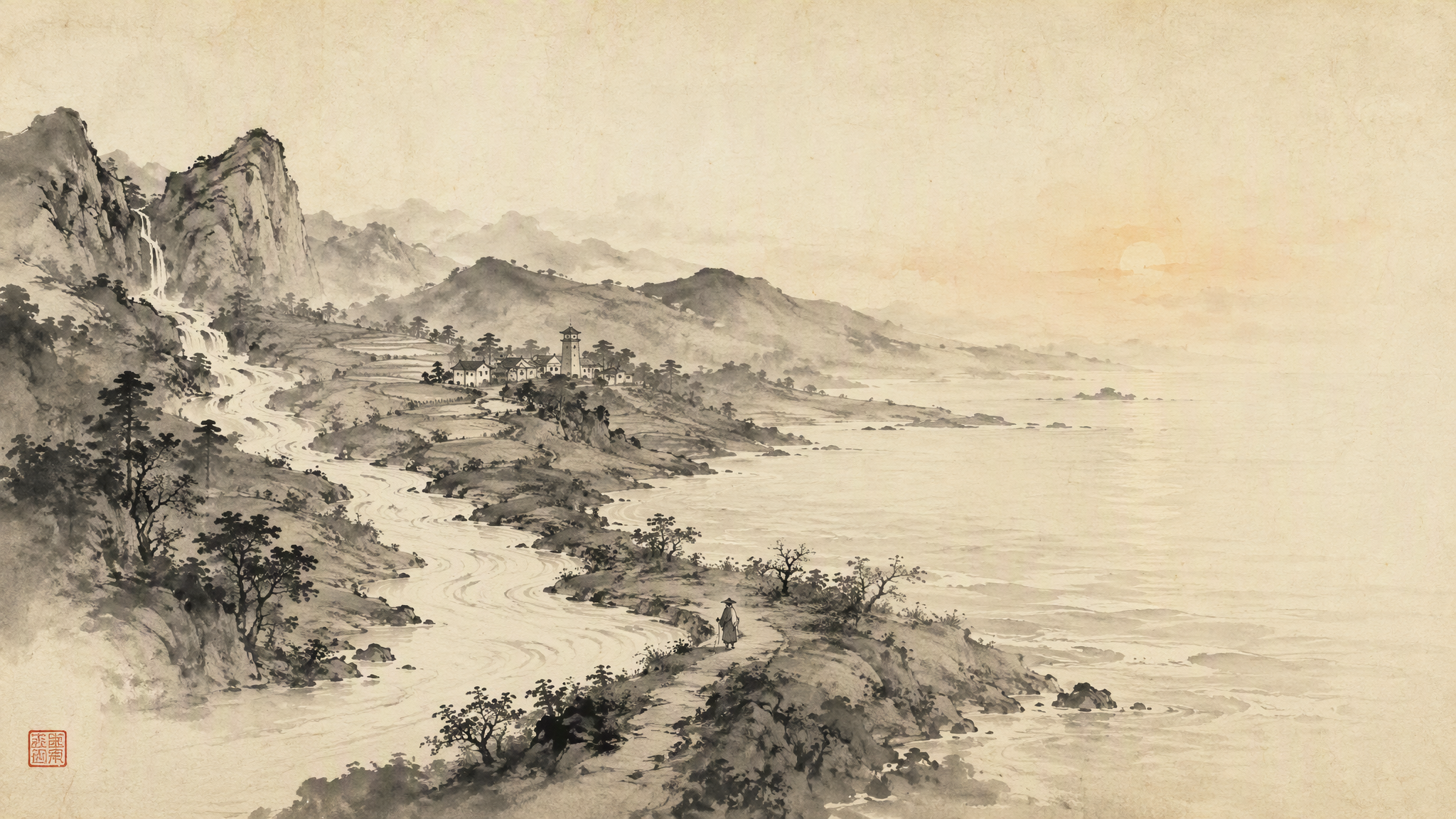
Truth flows, like rivers flow, like light flows. They feed ponds or lakes, and light reflects with clarity on their surface. The river stays clear by moving; the pond continues to reflect clear light so long as the river flows into it. A pond, or even a lake, that holds still water becomes stagnant, its reflection tinted. This handbook is based on twenty-five centuries of transmission and reflection of the same light through tradition and fresh daily practice. We illustrate measures of movement to enhance a clearer version of our own selves — a practice providing balance at a natural pace.

TAO TE JING · CH. 8The highest good is like waterThe highest good is like water. Water benefits all things and does not compete; it settles in places people disdain — and in this it is close to the Tao.
Nothing in the world is softer and weaker than water, yet nothing surpasses it in attacking the hard and strong. (ch. 78)
Laozi · ~6th–5th century BCE
ZHUANGZI · AUTUMN FLOODSThe River Earl meets the North SeaThe River Earl, swollen with autumn floods, believed all beauty in the world belonged to him — until he reached the North Sea and saw the water without end.
You cannot discuss the ocean with a frog in a well; you cannot discuss ice with a summer insect; you cannot discuss the Way with a cramped scholar.
Zhuangzi · ~4th–3rd century BCE
QURAN · 21:30We made from water every living thingAnd We made from water every living thing. (21:30)
The two bodies of water, one sweet and one salty — between them a barrier they do not cross. (25:53, 55:19–20)
Revealed · 7th century CE
The human being as a small order inside the great order — a research program running from Plato’s Timaeus through the Brethren of Purity (c. 900–1000 CE) to Ibn ʿArabī. Looking inward becomes a way of understanding the universe.
| The world | The body | The shared law |
|---|---|---|
| Rivers, streams, springs | Veins and arteries | Water carried across the land; blood carried across the body — one circulation. |
| Oceans and seas | Stomach and bladder | The grand reservoirs that collect, store, and return. |
| Rain and dew | Tears, sweat, saliva | Climate regulation: the sky weeps, the body cools; both purge and balance. |
| Mountains and rocks | Bones and skeleton | The pegs that stabilize the crust; the frame that holds the body upright. |
| Vegetation and trees | Hair | What grows from the surface, covering it and answering the inner climate. |
| Earthquakes and volcanoes | Fever and shivering | Pent-up pressure released: the earth quakes; the body burns and shakes. |
One bridge, named once: fitrah (فطرة) is to Islam what ziran (自然) is to Taoism — the claim that the deepest human truth is not imposed from outside but uncovered from within. The whole handbook is built on it: the sun sets the measure, the zones spend it, and the body already knows the way.
Eight levers recur in the modern performance literature — measured, cautious, never dogmatic. Each one was already somewhere in this day: the science states the mechanism; the echo shows where the tradition and the handbook were quietly holding it all along.
| The lever | The science | The echo |
|---|---|---|
| Sunlight in the eyes within the first hour | Melanopsin cells fire the brain’s master clock; the cortisol awakening response sets alertness, mood, and tonight’s melatonin. | The green-zone walk — real light before any screen. |
| Water before anything else | Waking hydration engages vagal pathways that raise brain arousal gently, without a stimulant. | The Fajr ritual itself: stand up, water, one sentence. |
| Hard movement early in the day | Resistance work in the first three hours is a useful cortisol spike — a preparation state, not stress. | Green-zone movement: the body is fed before it is asked. |
| The physiological sigh — double inhale, long exhale | The long exhale raises parasympathetic tone within a minute; the fastest known brake pedal. | The wave trough taken seriously; sujud’s measured settling. |
| A light walk after meals | Slow-twitch calf work clears glucose smoothly — no spike, no crash. | The Dhuhr pause taken on foot; the orange evening stroll. |
| Dark nights, side-sleeping, slight elevation | Melatonin stays clean and the glymphatic system clears the day’s metabolic waste from the brain. | The purple zone — Isha dimming through to Fajr. |
| One voluntary hard thing daily | Embraced challenge trains the brain’s tenacity circuitry — willpower as a muscle with a donor organ. | The commitment gate: crossing into blue is a choice, renewed daily. |
| Shut up, suit up, show up — then non-doing | Role engagement builds resilience; contemplative stillness restores direction and calm. | Niyyah — intention — at every threshold; wu wei inside the wave. |
Wu xing (五行) means “five movements”, not five elements — a two-thousand-year-old model of nourishment and restraint. Not validated physiology; a diagnostic poetics that has organized clinical observation for two millennia. The window is honored as a window.
The generating (Sheng) cycle: Water nourishes Wood, Wood feeds Fire, Fire creates Earth, Earth bears Metal, Metal enriches Water. Each phase mothers the next — the order is the medicine.
The same five movements read the body’s systems as a map — correspondence, not mechanism. Each system keeps its own voice; the phase names its weather. The window is honored as a window.
| System | Its voice | Phase | The resonance |
|---|---|---|---|
| Nervous | the electric whisper | Fire | The Heart holds the Shen — the mind — in TCM; agitation and insomnia are Fire unanchored by Water. |
| Cardiovascular | the rhythmic tide | Fire | The pulse is Fire’s drumbeat; joy and over-excitement both live here. |
| Respiratory | the invisible tide | Metal | The Lungs are Metal: breath as boundary, the exhale as letting go. |
| Digestive | the alchemical furnace | Earth | Spleen and Stomach transform food into substance — and worry into knots when Earth is overworked. |
| Muscular | the tensile architecture | Wood | The Liver governs the sinews: smooth movement is Wood bending without breaking. |
| Skeletal | the silent scaffold | Water | The Kidneys govern bone and marrow — the deepest structure draws on the deepest reserve. |
| Skin | the living boundary | Metal | Skin is the Lung’s outer leaf — the boundary that breathes. |
| Endocrine | the chemical choir | Water | Hormonal tides answer to the Kidney depths: slow chemistry, long cycles. |
| Immune | the invisible sentinel | Earth | Defense is nourishment’s other face — the Spleen’s stewardship of what belongs and what does not. |
| Urinary | filtration and balance | Water | Filtration is Water’s own work; the Kidneys and Bladder share the phase. |
| Sensory | the translation layer | Wood | The Liver opens into the eyes — the senses are how the rising world enters. |
The qailūla — the prophetic noon nap — is the same pause the organ clock gives the Heart between 11:00 and 13:00: settle, do not strive. When the night held four cycles instead of five, a whole extra wave of rest fits between Duha and Asr. The wheel bends; it does not break.
Five times a day the tradition moves the body through the same seven geometries; qigong and tai chi have taught their twins for two millennia. The gallery draws each posture as the same body in one line — biomechanics universal, tradition names behind the toggle.
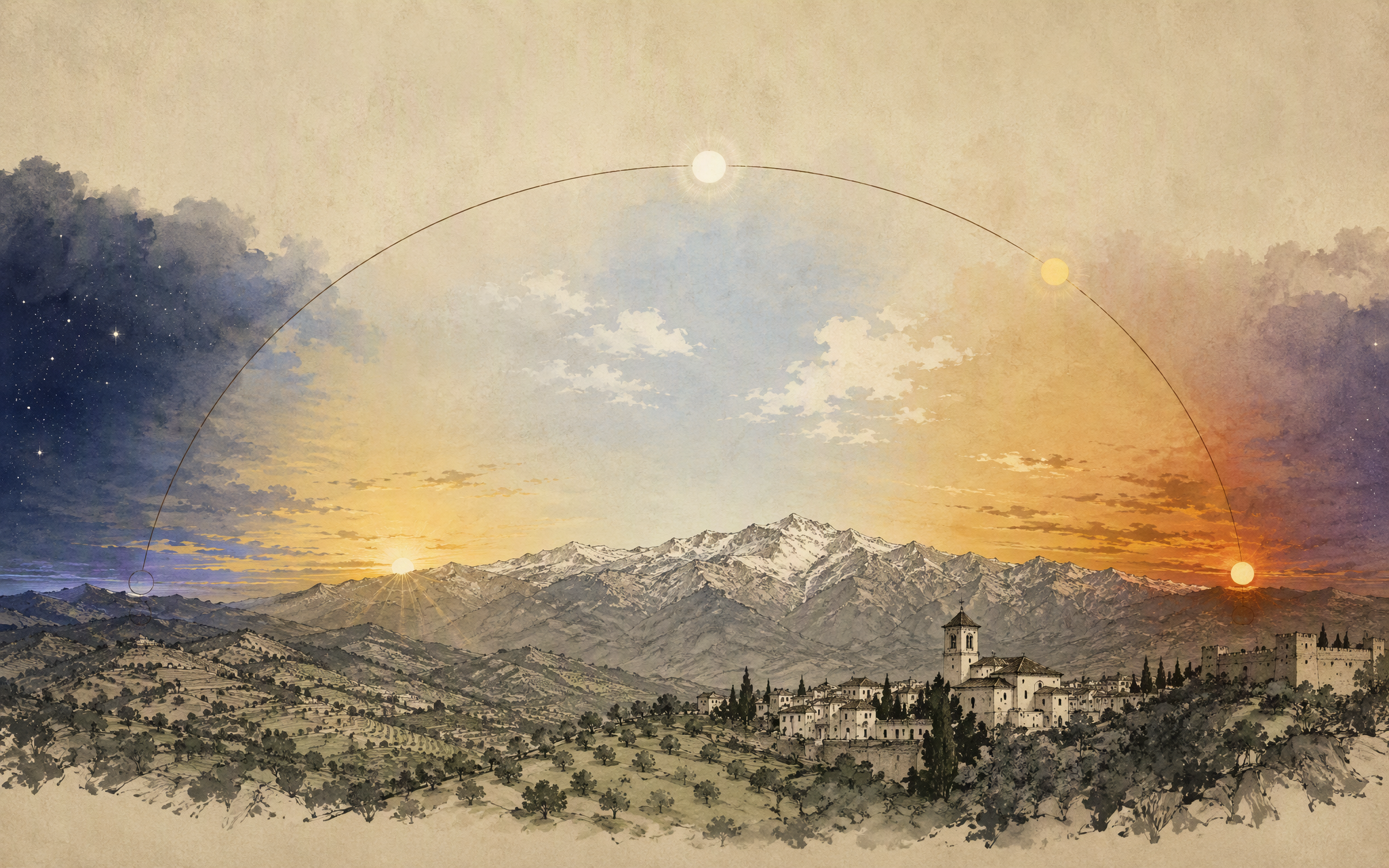
Because the zones are anchored to the traditional Islamic solar day, they drift with the seasons and never decouple from daylight. The sheet does this arithmetic by itself; the only manual act is noticing that green got shorter and not pretending it didn’t.

Fajr creeps earlier and the green zone stretches. Morning light outside before the blue zone begins becomes easy again — take it; it advances the whole clock.
Blue is at its longest and the day feels endless. The spec is explicit: never inflate beyond the 6-hour cap just because blue is long.
Green 06:19 → 11:00; Span 1 11:00 → 14:12 broken at Absolute Noon; Span 2 14:12 → 17:48 broken at Asr; orange from 20:35. The handbook’s model day.
Blue may hold only one full span plus a partial. The spec is gentle here: that is not a failure — the sun set the measure.

THE SOLAR YEAR · 24 TERMS · THE ZONES DRIFT WITH THE SUN
Green starts to stretch; Fajr creeps earlier.
Morning light returns; the anchor gets cheaper.
Blue lengthens; the cap still holds.
The balance point: green and blue near equal.
Walks lengthen; do not inflate ambition with daylight.
Orange slides later; protect the dimming.
Fajr early now; recount the bedtime.
Blue near its longest; two spans, never three.
Short nights begin; the countback matters most.
Longest blue of the year. Six hours is six hours.
Orange is late and short; guard the Isha dimming.
Siesta logic: the Dhuhr pause is the design.
The light turns; Fajr eases later.
Blue starts to hand time back to green.
The reference season: two spans, two crossings.
Balance again; the dial crosses its midpoint.
Green needs effort now; the walk is deliberate.
Orange stretches; lean into the earthing.
Blue shrinks; one span and a partial is a complete day.
Short blue; the sun set the measure — not a failure.
Long orange evenings: family, early nights.
Shortest blue of the year; keep the reset rule close.
The light anchor needs will; take it anyway.
Deep-reserves season; Water refills for spring.
The day counts by the sun; the month counts by the moon. The Islamic calendar never left the moon’s side — each month opens with the sighted crescent, and Ramadan arrives by it. The reckoning shown here is the tabular calendar: within a day of the sighted one.
Tonight: 19 Jumādā al-Ūlā 1448 · moon age 20.6 days
A dark night, no moon: the plant’s sap flows toward the roots and our own blood pools deeper, drawn inward by the quiet gravity of rest. Melatonin rises; energy withdraws to the core, to the bone. The hour of mending what the light has spent.
The first-lit smile: sap begins its slow ascent, and our own cortisol stirs. The soul grows receptive — synapses opening like stomata to catch the first silver signal. Growth begins in the dark, unseen.
The half moon in the east: energy divided between anchor and aspiration. Alertness peaks, reaction sharpens; the body balanced between the root’s memory and the leaf’s ambition. Half-formed things demand a direction.
Nearly full: the surge toward leaves and flowers, nutrients to the periphery in a final rush of expansion. We talk more, create more, push the unfinished toward its edge. The body knows the climax is near.
The bright night: everything lit silver. Deep sleep fragments, melatonin dips, dreams sharpen, emotions clarify — the boundary between the seen and the sensed grows thin. The ocean in us answers the ocean in the sky.
Retreating from fullness: sap withdraws from the canopy, sugars redirect downward. Inflammation softens; intensity gives way to integration — making sense of what was illuminated. The body’s long bookkeeping begins.
The half moon in the west: a decisive turn toward roots and storage, shedding what is spent to preserve what endures. Immune repair heightens; we prune, discard, separate the essential from the noise. The hour of editing.
The fading smile in the dawn sky: dormancy approaches, pathways seal against the coming dark. Metabolism slows; the soul grows still — not empty, but gathered, like water held in a cistern before the next season.
The sap imagery follows biodynamic and folk observation; what is measured in humans is the full moon itself — deep sleep measurably shortens and melatonin dips near it. The rest is the tradition’s poetry, offered as poetry.
The sun sets the day’s measure; the moon sets the month’s — and the months set a slower ledger still. The Hijri year walks eleven days against the solar one, so across about thirty-three years the inward months visit every season the zones know: the two calendars breathe against each other, and neither owns the year outright. The old tradition divided that ledger in two — months for the outward campaign, and months kept back for the well. The executive’s art is the same art: know which season it is before you spend it. A draft reading, offered as the phases above are offered.
Most of the year is for building, dealing, and shipping — worldly goals moved by daylight logic. Campaign, but as the old strategists taught: choose the ground before the march, time the push before you make it, and rest the line between efforts. A campaign that runs all year is not a campaign; it is a slow spending of the well.
The first of the kept months — by old custom the outward campaigns pause in it. Read here as the quarter where nothing launches: draw from the well, mend the tools, settle the accounts, let the ground lie fallow.
The month of preparation before the fast. Rehearse the discipline in miniature: trim the calendar, close the open loops, practice the rhythm you intend to keep. What is not rehearsed here is improvised later.
The month itself: the fast, the night prayers, the reading. Work continues but the harvest is inward — the month that refounds the year. Enter it with the calendar already light; the fast reveals whatever the year has been carrying.
The season of the great journey — the year’s outward act turned inward: travel as remembering. For the one who stays the lesson holds: make one deliberate journey this month, and let it mean something.
The Taoist mirror: wu wei — nothing forced, yet nothing left undone. The inward months are the year’s wu wei, the stillness that refills the well so the campaign season has something to draw. Yin does not lose to yang; it precedes it. The calendar is the tradition’s — the season you are in is yours to read.
“Perfect Day” is aspirational, not literal: the handbook’s robustness comes from the next-marker reset rule — any blown boundary is absorbed without penance at the next marker. Perfection is the return, not the streak. v0.1 · Quéntar, Granada · September 2026.